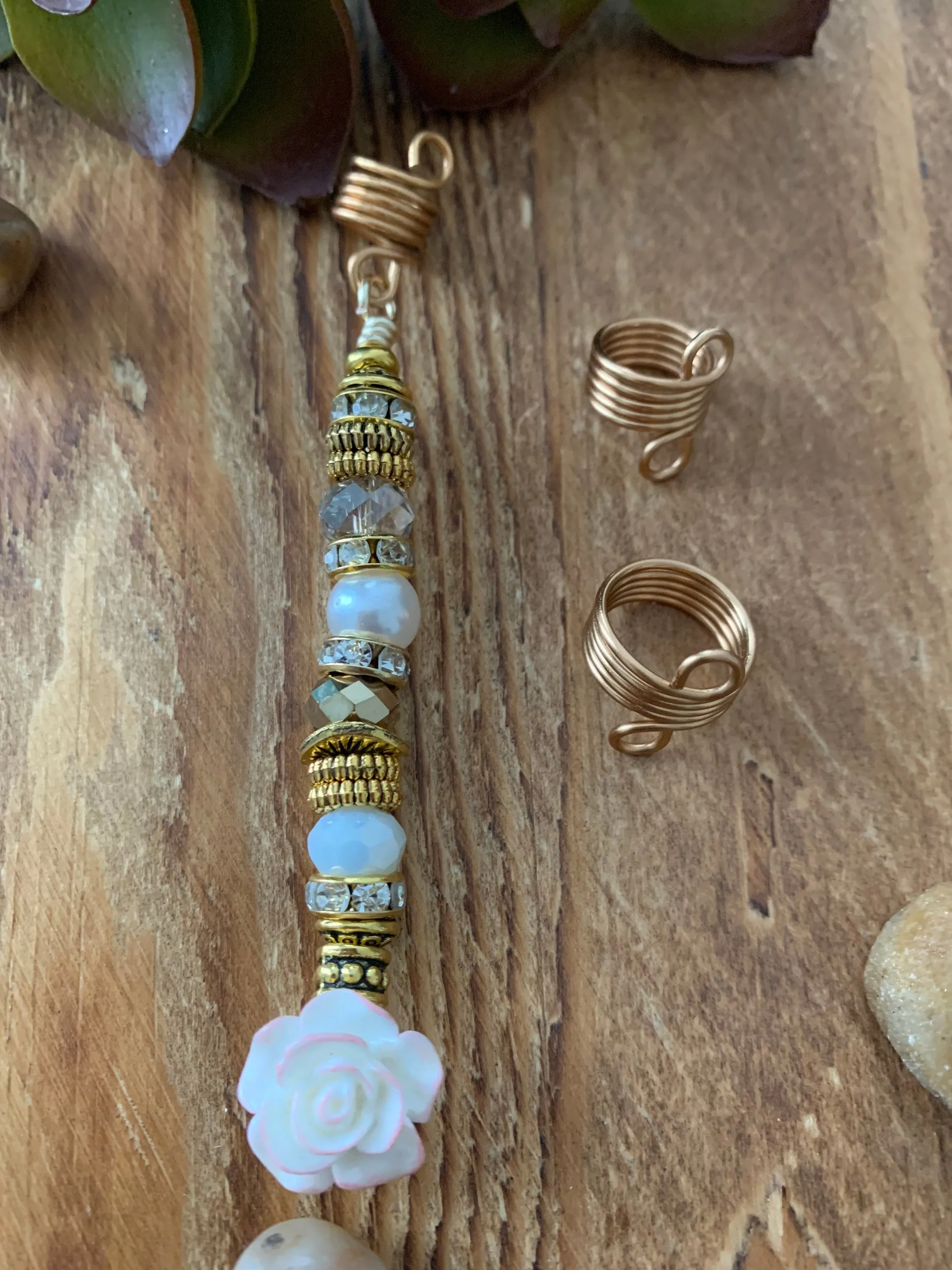
A loc updo is more than a way to get your hair off your neck. It can make a familiar retwist feel new, show off a neckline or pair of earrings, and give you a clear silhouette for work, dinner, travel, or a celebration. The best one is not always the tallest or most detailed. It is the shape that feels secure, looks intentional, and still lets your locs be themselves.
Start with comfort, then build the look. A simple low bun can carry as much presence as a crown style when the placement is right. These loc updo styles are meant to be adapted for your length, density, and real plans for the day, with room for one handmade detail when you want the finish to say a little more.
Choose the anchor point before styling
Every updo begins with an anchor point: low at the nape, in the middle of the head, high at the crown, or off to one side. Hold your locs in each position before committing. Notice where the weight feels balanced and where your face, neckline, and outfit look most like you. This quick mirror test is more useful than copying a picture that was made for somebody else's length or density.
Comfort is not optional. The American Academy of Dermatology notes that tightly pulled buns, ponytails, and updos can put repeated stress on the scalp. If a style hurts, feels too tight, or makes your edges feel stretched, loosen it or choose a lower anchor. A polished look should not leave you waiting to take it down.
1. The low loc bun
The low bun is the quiet, elegant choice. Gather your locs at the nape, twist or fold the length into a soft bundle, and secure it without flattening the rest of the shape. This style works especially well when your locs are long or dense because it keeps the weight close to the neck instead of asking the hairline to carry it all.
Make it yours with a side or center part, then resist the urge to make every line perfectly tight. A little texture gives the bun a softer, more natural finish. For an everyday version, leave it clean and simple. For a dinner or event, add one charm low on the side where it can be noticed when you turn your head.

2. The half-up crown
A half-up crown gives you lift while keeping plenty of movement through the lower locs. Select the upper section that naturally frames your face, gather it just below or at the crown, and create a compact bun or twist. The lower locs stay loose, so the style works well when a full updo feels too heavy or when your locs are still growing toward the length you want.
This is a useful style for a casual day that turns into plans later. Start with a small upper section. Add more only if the shape needs it. You can keep the front soft, let a few locs fall naturally, or make a clean part if you want a more sculptural result. A charm at the change between the gathered and loose sections makes the style feel finished without requiring a full row of jewelry.
3. The side-swept tuck
For an updo that feels softer than a full bun, gather your locs toward one side and tuck the length into a low side coil behind the ear. This gives you an open neckline and an asymmetrical outline that reads beautifully in photos. It is also practical when you know a bag strap, jacket collar, or headset is usually on one shoulder: place the tuck on the opposite side so your locs are not constantly being pushed around.
Keep the tuck low enough that the temple does not feel strained. Look at both profiles before you leave. If one side feels too heavy, let a few locs fall free rather than pulling harder. A small cuff near the base or a single charm toward the shoulder gives the side sweep a focal point while keeping the look relaxed.
4. The wrapped-base bun
The wrapped-base bun turns a straightforward updo into something that looks considered. Build a comfortable low or mid bun first. Then choose one loc with enough length to circle the base once, without tugging it tight, and secure the end gently. The wrap gives the bun a clean finish and can hide a tie while letting the natural texture of your locs stay visible.
Check the base after you wrap it. You should still be able to move your head freely, and the bun should not feel harder than it did a minute ago. If the wrap adds tension, skip it. A small loc cuff can create the same finished effect with less pull. The detail should support the style, not become a reason the style is uncomfortable.
For a workday, this can be the whole look. For an evening out, choose one loc near the wrap and add a small piece of jewelry where the line changes direction. That gives the eye a place to land without turning the bun into a wall of details. If the accessory seems to disappear, move it slightly closer to the face or leave it out. Not every updo needs a visible accent to feel complete.

5. The soft high bun
A high bun has instant presence. It opens the face, shows off your neck and earrings, and makes a simple outfit feel dressed. The gentler way to wear it is to place the anchor near the crown, rather than pulling everything toward the front hairline. Gather in stages with your hands, then secure the base with enough hold to keep the bun stable, not so much that it feels locked in place.
High styles are best treated as a choice in a rotation, not a requirement every day. The National Library of Medicine describes traction alopecia as hair loss caused by continuous pulling on the roots. Use that as a practical styling cue: if your crown or edges feel tender, bring the bun lower or choose a half-up version instead.
When you are testing a high bun, do more than look in the mirror. Turn your head from side to side, glance down at your phone, reach for something overhead, and put on the outer layer you expect to wear. The style should move with you without shifting or making you aware of the base. If it changes the way you naturally carry your head, it is asking too much.
6. The two-bun updo
Two buns give shorter or medium-length locs a playful, balanced way to wear hair up. Part the locs down the middle or slightly off-center, then build one bun on each side. Keep the bases broad and low enough that the buns sit in balance rather than pulling at the temples. The goal is two clear shapes, not two tiny knots pulled as tight as possible.
This style has room for a little color. Choose matching cuffs for each side, or let one colorful charm be the only focal point. Repeating one material, such as gold-tone wire or a single jewel tone, creates connection without making the buns compete with each other. It is a good reminder that symmetry can come from repeated detail, not from making every loc sit exactly the same way.
Two buns also make it easier to adjust the style as your day goes on. If one side begins to feel tight, you can loosen and rebuild that side without undoing everything. Keep the overall outline soft enough that the buns read as a pair from the front, but do not worry if they are not identical. Locs have their own character, and a little variation makes the result feel lived-in rather than overworked.

How to add jewelry without crowding the updo
Updos already have a lot of visual architecture, so accessories work best when they are edited. Choose the place you want someone to notice first: near the face, at the bun base, down one side, or at the crown. Place one focal piece there, step back, and assess the style from the front and both sides. Often, that is enough.
- Pick one focal area. Let a charm, cuff cluster, or color story lead the eye.
- Repeat one element only if it helps. A second, smaller detail can connect the look, but it does not need to match every feature.
- Leave breathing room. Space is what lets both the updo and the handmade details read clearly.
- Test your real routine. Turn your head, put on your jacket, and check any piece that could catch before you call the look done.
For more placement ideas, the Journal's hair charm guide and loc ponytail guide can help you decide which detail belongs where. The goal is not to add everything at once. It is to make one choice that feels intentional.
Give the updo a gentle finish
Before you leave, do one last comfort check. Your scalp should feel calm, the weight should feel evenly supported, and no accessory should catch when you put on a scarf, coat, or bag. If you are wearing a piece for the first time, a simpler placement is often smarter than building a full statement around it. You can always add more on another day.
At night, take out any jewelry that feels bulky or likely to snag, and release the updo if it is not comfortable to sleep in. Store your cuffs and charms somewhere dry and easy to see, such as a small dish near where you get ready. That turns the pieces you already love into real options, instead of special-occasion extras you forget you own.
The right loc updo gives you structure without asking you to be precious about every strand. Pick the anchor point that works for your day, let the shape breathe, and make comfort the detail that holds everything together.
Find handmade details for your next updo
Cyere's Closet makes loc jewelry for the moments when your hair is part of the outfit. The Goddess Charm is a strong single focal piece for a low bun or side tuck. For color that can carry a simpler shape, the Starlit Mosaic adornment brings a brighter point of view.
If you prefer an understated finish, the Just the Cuffs set gives you smaller details that can follow the curve of a bun. Browse the full Loc Jewelry collection when you are ready to find the piece that feels like yours. Build the shape first, keep the tension kind, and let one meaningful detail do the rest.
Frequently Asked Questions
Are loc updos safe to wear every day?
They can be, provided the style feels comfortable and you rotate where the weight sits. A good updo should not sting, throb, pull at the edges, or leave your scalp sore when you take it down.
What is an easy updo for shorter locs?
A half-up bun, two small buns, or a side sweep can create lift without asking every loc to reach the crown. Start with the section that naturally gathers, then leave the rest loose.
How do I keep a loc updo from looking too busy?
Choose the shape first, then give one detail the lead. A focal charm, a small cuff cluster, or one color story is usually enough. Leaving space around the accents keeps the updo readable.
Where should I place jewelry in a loc updo?
Place it where the eye naturally lands: near the face, at the bun base, along a side sweep, or at the crown. Check the placement from the front and both sides before adding anything else.